Lamination and Drilling
Esta página aún no está disponible en tu idioma.
Lamination and Drilling
Overview
Section titled “Overview”Once the inner cores are ready, they must be pressed together with copper foils into a complete multilayer board — that is lamination. Then drilling punches through-holes that connect the layers, preparing for hole metallization. This article covers all six steps of the B stage.
Process Chain Overview
Section titled “Process Chain Overview”Lamination & drilling process chainBrown Oxide → Riveting → Lay-up → Pressing → Post-treatment → Drilling │ │ │ │ │ └─ drill layer-to-layer vias │ │ │ │ └─ edge grinding / target drilling / routing; tooling holes │ │ │ └─ hot pressing (kraft paper + steel plates) │ │ └─ foil + prepreg + core lay-up │ └─ rivets pin multiple inner layers together └─ roughen copper surface to bond with resin01 Brown Oxide
Section titled “01 Brown Oxide”Purpose (three aspects):
- Roughen the copper surface to increase contact area with resin
- Improve wettability of the copper surface to flowing resin
- Passivate the copper surface to avoid undesirable reactions
Main material: brown oxide solution MS100.
Note: the brown oxide film is very thin and scratches extremely easily — handle with care. Brown oxide quality directly determines copper-to-resin bonding after lamination; a scratch becomes a future delamination risk.
02 Riveting
Section titled “02 Riveting”Purpose: rivet multiple inner layers together to prevent interlayer slippage during subsequent processing (4-layer boards do not need rivets; they are used when layer counts are higher).
Main materials: rivets, prepreg (P/P).
Prepreg is the “glue” of lamination, composed of resin and glass fiber cloth:
- By glass cloth type: 106, 1080, 3313, 2116, 7628, etc.
- By resin cross-linking state, three classes:
- A-stage: fully uncured
- B-stage: semi-cured (production uses B-stage prepreg)
- C-stage: fully cured
The lamination principle is exactly this: B-stage resin flows, fills, and cures under heat and pressure — bonding all layers into one.
03 Lay-up
Section titled “03 Lay-up”Purpose: stack the pre-assembled panels into the form ready for pressing.
Main materials: copper foil, prepreg, inner cores. Electro-deposited copper foil by thickness:
| Code | Thickness | Common name |
|---|---|---|
| T | 12 μm | 1/3 oz |
| H | 18 μm | 1/2 oz |
| 1 | 35 μm | 1 oz |
| 2 | 70 μm | 2 oz |
The stacking order (foil-prepreg-core-prepreg-foil…) determines the final layer sequence and must strictly follow the engineered stack-up.
04 Pressing
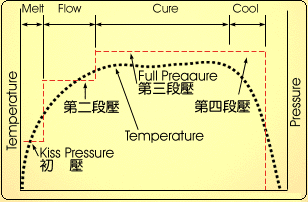
Section titled “04 Pressing”Purpose: press the stacked panels into a multilayer board by hot pressing.
Main auxiliaries: kraft paper, steel plates, carrier plates.
During pressing, the stack is sandwiched between steel plates, with kraft paper providing pressure-transmission cushioning, while hot plates apply temperature and pressure. Multiple stacks can be pressed simultaneously, multiplying throughput — which is exactly what the carrier plate enables.
05 Post-treatment
Section titled “05 Post-treatment”Purpose: edge grinding, target drilling, and routing of the pressed panel for preliminary profile processing — meeting quality-control requirements and providing the tooling holes for subsequent processes.
Main materials: drill bits, routers.
“Target drilling” drills the target holes — establishing the unified datum system for all later registration steps (drilling, exposure, profiling).
06 Drilling
Section titled “06 Drilling”Purpose: drill through-holes on the board that connect the layers electrically.
Main materials and their roles:
- Drill bit: made of tungsten carbide, cobalt, and organic binders — the cutting core
- Entry board (aluminum sheet):
- drill registration
- heat dissipation
- reduce hole-entry burrs
- protect the panel surface from the pressure foot
- Backup board (composite, on the exit side):
- protect the drilling machine table
- prevent exit-side burrs
- lower drill bit temperature
- clean resin smear from the drill flutes
Drilling quality (hole-wall finish, hole-position accuracy) directly affects hole metallization yield — a rough hole wall or residual smear leads to discontinuous plating.

Summary
Section titled “Summary”- Lamination = copper foil + prepreg (B-stage resin) + inner cores, hot-pressed and cured; brown oxide and riveting are the two quality prerequisites
- The copper foil thickness codes (T/H/1/2) appear in daily design communication — worth remembering
- The “entry board + backup board” system solves three problems: registration, heat, and burrs
- Post-treatment target holes establish the process-wide datum, paving the way for hole metallization
Next up: hole metallization — making the insulating hole walls “grow” copper to achieve true layer-to-layer electrical connection.
We provide ESP32 ODM design-to-manufacturing services. From prototype to production — the team behind this tutorial can build it with you.
Talk to us →