Business Model Canvas for IoT Business Design
Business Model Canvas for IoT Business Design
Section titled “Business Model Canvas for IoT Business Design”Overview
Section titled “Overview”This section introduces the Business Model Canvas (BMC) framework and its application to IoT solution business design. Developed by Alexander Osterwalder, the BMC is a standardized tool for describing, analyzing, and designing business models. Upon completion, you will be able to:
- Understand the 9 building blocks of the BMC and their interrelationships
- Use BMC to analyze IoT project business models and identify value propositions and revenue streams
- Evaluate solution business feasibility with BMC, identifying potential risks and opportunities
- Combine BMC with JTBD and SCQA to build a complete business narrative
Prerequisites
Section titled “Prerequisites”Before starting this section, ensure you have:
- Completed sections 01-05 (JTBD, Ethnography, SCQA, and Pre-Sales Proposals)
- Basic understanding of IoT project cost and revenue structures
- A real IoT project or product to use as a practice example
Core Concepts
Section titled “Core Concepts”What is the Business Model Canvas?
Section titled “What is the Business Model Canvas?”The Business Model Canvas is a visual framework that standardizes business model elements into 9 building blocks on a single page, enabling rapid team discussion and iteration.
A business model describes the rationale of how an organization creates, delivers, and captures value. — Alexander Osterwalder
Comparison with Traditional Business Plans:
| Dimension | Traditional Business Plan | Business Model Canvas |
|---|---|---|
| Format | Text document (many pages) | One-page visual |
| Update Speed | Slow, costly to rewrite | Fast, change with sticky notes |
| Team Collaboration | One writes, many read | Everyone participates |
| Focus | Financial projections | Value logic |
| Best For | Fundraising, formal launch | Early exploration, rapid iteration |
IoT Practitioner Note: Many IoT projects fail not because of technology, but because the business model wasn’t thought through (how to make money? who pays? is the cost structure sustainable?). BMC helps you clarify these questions before investing in development.
The Nine Building Blocks
Section titled “The Nine Building Blocks”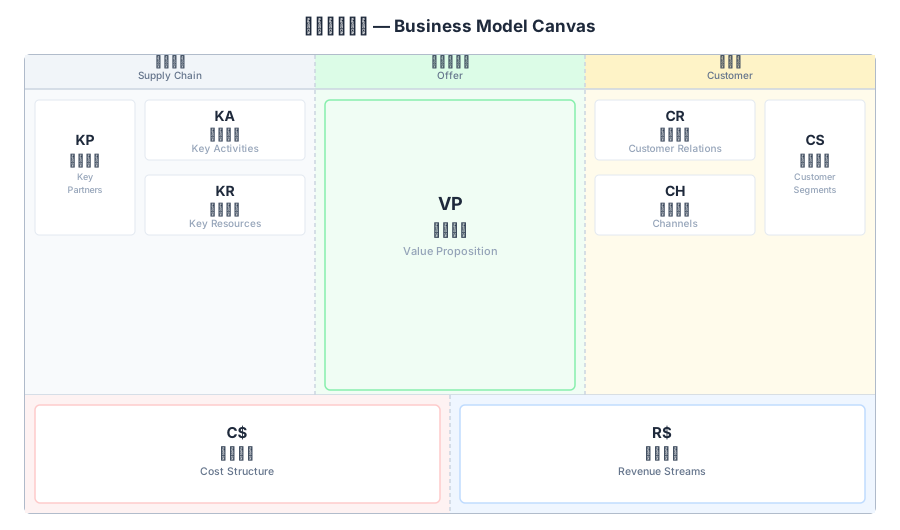
Module Details (IoT Context)
Section titled “Module Details (IoT Context)”1. Customer Segments (CS) — Who are your customers?
Section titled “1. Customer Segments (CS) — Who are your customers?”Definition: The different groups of people or organizations an enterprise aims to reach and serve.
Key Questions:
- For whom are we creating value?
- Who are our most important customers?
- What types of customers exist? What are their characteristics?
IoT Examples:
| Type | Description | IoT Case |
|---|---|---|
| Mass Market | Large audience, no significant differentiation | Smart home devices (end consumers) |
| Niche Market | Specific segment | Chemical plant gas monitoring systems |
| Diversified | Multiple unrelated markets | Temperature/humidity sensors (agriculture + cold chain + warehousing) |
| Multi-sided Platform | Connect multiple groups | IoT device management platform (device manufacturers + app developers + end users) |
Distinguish Customer, User, and Payer:
- Customer: Purchase decision maker
- User: Actual product user
- Payer: The one who pays
💡 In B2B IoT scenarios, these are often different: CEO (customer) signs off, Plant Manager (user) operates daily, Finance Department (payer) issues payment.
2. Value Proposition (VP) — What job do you help customers complete?
Section titled “2. Value Proposition (VP) — What job do you help customers complete?”Definition: The bundle of products and services that create value for a specific Customer Segment.
Key Questions:
- What problems are we helping customers solve?
- What needs are we satisfying?
- What unique value do we deliver for each segment?
Types of Value Propositions (Combined with JTBD):
| Type | Description | IoT Example |
|---|---|---|
| Newness | Something never possible before | First-ever remote equipment monitoring |
| Performance | Do it better | Alert response from 4 hours to 5 minutes |
| Customization | Tailored to individual needs | Custom alert thresholds per production line |
| Cost Reduction | Save money | Reduce manual inspection costs |
| Risk Reduction | Prevent losses | Early warning to prevent equipment damage |
| Accessibility | Make it affordable for more people | Low-cost sensor solutions |
JTBD Value Proposition Expression:
❌ Technical Language: "Provides real-time data collection and visualization"✅ Value Language: "Reduces your workshop anomaly response time from 4 hours to 5 minutes, saving ¥2M+ in production downtime losses annually"✅ Emotional Value: "No more 3 AM phone calls"✅ Social Value: "Demonstrates a professional digital management system to regulators"3. Channels (CH) — How do you reach customers?
Section titled “3. Channels (CH) — How do you reach customers?”Definition: How a company communicates with and reaches its Customer Segments to deliver a Value Proposition.
Key Questions:
- Through which channels do our customers want to be reached?
- How do we raise awareness? (Awareness)
- How do we help customers evaluate our offering? (Evaluation)
- How do we allow customers to purchase? (Purchase)
- How do we deliver the value proposition? (Delivery)
- How do we provide post-purchase support? (After-sales)
IoT Channel Examples:
| Stage | Channel | IoT Example |
|---|---|---|
| Awareness | Industry exhibitions | Show smart factory solution at trade show |
| Evaluation | Solution demo | On-site PoC (Proof of Concept) |
| Purchase | Direct sales/integrator | Sign contract through automation system integrator |
| Delivery | On-site implementation | Hardware deployment + system integration |
| After-sales | Remote operations | 7×24 remote monitoring + regular inspection |
4. Customer Relationships (CR) — How do you maintain customer relationships?
Section titled “4. Customer Relationships (CR) — How do you maintain customer relationships?”Definition: The types of relationships a company establishes with specific Customer Segments.
Key Questions:
- What relationship does each Customer Segment expect?
- What is the cost of maintaining these relationships?
- How do we move from one-time transactions to ongoing service?
IoT Customer Relationship Types:
| Type | Description | IoT Case |
|---|---|---|
| Consultative | Professional technical advisory | Pre-sales consultation + one-on-one system design |
| Managed Service | Complete service provider management | Device-as-a-Service, annual subscription |
| Self-Service | Customers use product independently | SaaS IoT platform, customer self-configuration |
| Community | Customers help each other | IoT developer forum + user community |
5. Revenue Streams (R$) — How do you make money?
Section titled “5. Revenue Streams (R$) — How do you make money?”Definition: The cash a company generates from each Customer Segment.
Key Questions:
- What value are customers willing to pay for?
- How do they currently pay? How would they prefer to pay?
- What is each revenue stream’s contribution to total revenue?
IoT Revenue Models:
| Model | Description | IoT Case |
|---|---|---|
| Hardware Sales | One-time device sale | Sensor nodes |
| Software License | License-based fee | Monitoring platform license |
| Subscription | Monthly/annual fee | SaaS platform subscription |
| Usage-based | Pay-per-use | Data volume × unit price |
| Leasing | Equipment lease | Sensors-as-a-Service |
| Value-added Services | Additional service fee | Custom report development |
Revenue Model Strategy:
One-time Revenue (Hardware)    Recurring Revenue (Service)          ↓                            ↓    Fast cash flow              Predictable revenue    Low customer stickiness     High customer stickiness    Large per-order amount      Small per-order amount    Periodic fluctuations       Stable revenue
Recommended IoT Strategy: Hardware + Service Hybrid  One-time: Sensor hardware cost  Recurring: Platform annual fee / O&M service fee  Value-added: Custom development / data analysis reports
6. Key Resources (KR) — What do you have?
Section titled “6. Key Resources (KR) — What do you have?”Definition: The most important assets required to make a business model work.
Key Questions:
- What resources does our Value Proposition require?
- What resources do our Channels require?
- What resources do our Customer Relationships require?
- What resources do our Revenue Streams require?
IoT Key Resource Types:
| Type | Description | IoT Example |
|---|---|---|
| Physical | Hardware, equipment, facilities | ESP32, sensors, production workshop |
| Intellectual | Technical capability, patents, methods | Embedded development, IoT architecture experience |
| Human | Team experience, relationships | Senior architects, industry relationships |
| Financial | Capital, funding | R&D investment, project bridging finance |
7. Key Activities (KA) — What do you do?
Section titled “7. Key Activities (KA) — What do you do?”Definition: The most important things a company must do to make its business model work.
Key Questions:
- What activities does our Value Proposition require?
- What activities do our Channels require?
- What activities do our Customer Relationships require?
- What activities do our Revenue Streams require?
IoT Key Activity Examples:
Hardware R&D → Firmware Dev → Platform Build → Field Install → O&M Support │ │ │ │ │ Sensor Sel. MQTT Impl. Node-RED Flows Cable Install Remote Mon. PCB Design Alert Logic Grafana Dash. Device Config FW Updates8. Key Partnerships (KP) — Who helps you?
Section titled “8. Key Partnerships (KP) — Who helps you?”Definition: The network of suppliers and partners that make the business model work.
Key Questions:
- Who are our Key Partners?
- What resources do we acquire from partners?
- What activities do partners perform?
IoT Ecosystem Partner Types:
| Partner | Value | IoT Example |
|---|---|---|
| Hardware Suppliers | Stable, low-cost devices | Sensor module manufacturers |
| Platform Providers | Infrastructure capabilities | Cloud providers (AWS/Azure/Aliyun) |
| System Integrators | Project implementation | Automation engineering companies |
| Channel Partners | Customer reach | Industry agents, regional distributors |
| Certification Bodies | Compliance endorsement | Explosion-proof certification, metrology certification |
9. Cost Structure (C$) — What do you spend?
Section titled “9. Cost Structure (C$) — What do you spend?”Definition: All costs incurred to operate a business model.
Key Questions:
- What are the most important costs in our business model?
- Which Key Resources are most expensive?
- Which Key Activities are most costly?
IoT Cost Structure Example:
| Cost Item | Type | Description |
|---|---|---|
| Hardware BOM | Variable | Sensor, PCB, enclosure, packaging |
| R&D Investment | Fixed | Embedded dev, platform dev, testing |
| Manufacturing Cost | Variable | SMT assembly, final assembly, QC |
| Implementation Cost | Project cost | Site survey, cabling, system commissioning |
| O&M Cost | Recurring | Server, bandwidth, remote O&M personnel |
| Certification Cost | One-time | 3C/FCC/CE certification fees |
Drawing the Business Model Canvas
Section titled “Drawing the Business Model Canvas”Step-by-Step Process
Section titled “Step-by-Step Process”Fill the canvas in this sequence (right to left, from value estimation to cost structure):
Step 1: Customer Segments (CS)    → Use JTBD + Ethnography to identify customers    → Focus on 2-3 most defined segments, don't spread too thin
Step 2: Value Proposition (VP)    → Define VP for each segment based on JTBD    → Distinguish functional, emotional, and social value
Step 3: Channels (CH)    → How do you reach these customers?    → What channels do customers prefer?
Step 4: Customer Relationships (CR)    → What relationship to establish and maintain?    → One-time transaction or ongoing service?
Step 5: Revenue Streams (R$)    → What value are customers willing to pay for?    → One-time or recurring?
Step 6: Key Resources (KR)    → What resources are needed for everything above?
Step 7: Key Activities (KA)    → What activities are needed for everything above?
Step 8: Key Partnerships (KP)    → What do you do yourself? What do partners do?
Step 9: Cost Structure (C$)    → What costs are incurred for everything above?
Complete IoT Canvas Example
Section titled “Complete IoT Canvas Example”Below is a Business Model Canvas for a “Food Processing Plant Environment Monitoring” project:
┌──────────────────────────────────────────────────────────────────────┐│ KP KA VP ││ Key Partners Key Activities Value Proposition ││ │ │ ││ ● Sensor mfr. ● Hardware R&D ● 7×24 auto monitoring ││ ● Cloud provider ● Platform Dev ● 30s anomaly alert ││ ● System integrator ● Field install ● ¥2M+ annual savings ││ ● Certification body ● O&M Support │ ││ │ │ ││ KR │ ││ Key Resources │ ││ │ │ ││ ● Embedded dev team │ ││ ● IoT platform │ ││ ● Project experience │ │├──────────────────────────┴─────────┬─────────┴──────────────────────┤│ CR CH │ CS ││ Customer Relations Channels │ Customer Segments ││ │ │ │ ││ ● Consultative ● Trade │ ● Small/med food processors ││ ● Managed O&M ● Integrator │ ● Chemical plants (comply) ││ ● Annual contract ● Referral │ ● Logistics (cold chain) ││ (recurring) ● Direct │ │├─────────────────────────┴──────────┴──────────────────────────────┤│ C$ Cost Structure │ R$ Revenue Streams ││ │ ││ ● Hardware BOM ¥200/unit │ ● Hardware ¥5,000/12-node ││ ● R&D amort. ¥50,000 │ ● Platform fee ¥3,000/year ││ ● Install cost ¥20,000 │ ● Installation ¥15,000/project││ ● Platform O&M ¥5,000/year │ ● O&M service ¥5,000/year ││ ● Certification ¥15,000 │ ● Value-added Custom pricing ││ │ ││ Total cost ~¥45,000/project │ Total revenue ~¥28,000/yr 1st ││ Marginal cost ~¥3,000/unit │ Annual renewal ¥8,000/yr 2nd+ │└──────────────────────────────────────────────────────────────────────┘Canvas Analysis:
| Dimension | Analysis |
|---|---|
| Profit Point | Year 1 from implementation margin, Year 2+ from renewals — more customers = more recurring revenue |
| Key Assumption | Customers willing to sign annual contracts (needs validation) |
| Main Cost | R&D amortization (cost per unit too high if only 5 units sold) |
| Scale Effect | Margin improves with standardized hardware BOM + install process |
| Risk | Channel dependency on integrators = reduced bargaining power |
Applying BMC to IoT Solution Design
Section titled “Applying BMC to IoT Solution Design”Evaluating Solution Feasibility with BMC
Section titled “Evaluating Solution Feasibility with BMC”Before development investment, use these questions to assess business viability:
| Dimension | Key Question | Red Flag |
|---|---|---|
| Need Validation | Is customer segment well-defined? Willing to pay? | ”Everyone is a customer” |
| Value Proposition | Is value quantifiable? Can competitors offer same? | ”Customers say nice but won’t pay” |
| Cost Structure | Cost per project vs revenue? Breakeven point? | ”Need to sell 100 units to break even” |
| Revenue Model | Is revenue sustainable? Churn rate manageable? | ”No revenue after hardware sale” |
| Delivery Capability | Can team deliver? External resources needed? | ”Trying to do everything in-house” |
| Competitive Moat | Is it easy to copy? | ”Anyone can do this” |
BMC + JTBD + SCQA Integrated Framework
Section titled “BMC + JTBD + SCQA Integrated Framework”Combining the three frameworks forms a complete chain from need discovery to business design:
JTBD (Sections 01-02) ↓ Identify jobs customers need to completeEthnography (Section 03) ↓ Validate real behavior and latent needsBMC (This Section) ↓ Design all 9 business model componentsSCQA (Section 04) ↓ Structure the solution narrativePre-Sales Proposal (Section 05) ↓ Write comprehensive proposal documentC4 Model (Sections 07-12) ↓ Prove technical feasibilityBusiness Model Innovation Exercise
Section titled “Business Model Innovation Exercise”Exercise: Draw a BMC for an IoT Project
Use this template to analyze an IoT project you’re familiar with:
## Business Model Canvas — [Project Name]
### 1. Customer Segments (CS)- Core customer: [Who pays?]- User: [Who uses?]- Typical customer profile: [One sentence]
### 2. Value Proposition (VP)- Functional value: [What job does it complete?]- Emotional value: [What anxiety does it relieve?]- Social value: [What image does it enhance?]- One-line VP: [Why would customers buy?]
### 3. Channels (CH)- Customer acquisition: [How do they find out?]- Solution delivery: [How do we deliver?]
### 4. Customer Relationships (CR)- Engagement model: [Transactional/Subscription/Managed?]
### 5. Revenue Streams (R$)- One-time: [Hardware/Implementation]- Recurring: [Annual fee/Service fee]
### 6. Key Resources (KR)- Technical: [Dev capability, platform, IP]- Relationships: [Customer relationships, channel relationships]
### 7. Key Activities (KA)- Core tasks: [R&D/Implementation/O&M]
### 8. Key Partnerships (KP)- Upstream: [Hardware suppliers]- Downstream: [Integrators, channel partners]
### 9. Cost Structure (C$)- Fixed costs: [R&D/Certification]- Variable costs: [Hardware/Implementation]
Verification
Section titled “Verification”Verify your understanding of the Business Model Canvas:
-
Framework Understanding
- Can name all 9 building blocks and their meanings
- Can explain the logical relationships between blocks
- Can distinguish customer, user, and payer
-
Canvas Drawing
- Can draw a complete BMC for an IoT project
- Can use the canvas to identify business risks and opportunities
- Can calculate per-project breakeven points
-
Integrated Application
- Can combine BMC with JTBD for value proposition analysis
- Can use BMC to evaluate business feasibility
- Can explain business model logic to non-technical stakeholders
Best Practices
Section titled “Best Practices”- ✅ Do: Use BMC as a discussion tool first, then write the business plan (one page > dozens of pages)
- ✅ Do: Have the team use sticky notes — everyone writes and posts on the canvas
- ✅ Do: Draw a separate canvas for each customer segment (different segments may have different models)
- ✅ Do: Review and update the canvas regularly (quarterly) — business models need continuous iteration
- ✅ Do: Use BMC + JTBD together — JTBD tells you “what job needs doing”, BMC tells you “how to make money doing it”
- ❌ Avoid: Trying to cover all customer segments at once (focus on 2-3 core segments)
- ❌ Avoid: Only drawing the “ideal state” canvas (also draw “current state” for gap comparison)
- ❌ Avoid: Single revenue stream reliance (hardware-only revenue is high risk)
- ❌ Avoid: Ignoring hidden costs in cost structure (after-sales O&M, customer acquisition costs)
Summary
Section titled “Summary”Key takeaways:
-
The Business Model Canvas is a visual business model analysis tool
- 9 building blocks cover all elements of a business model
- One page can describe an organization’s value creation, delivery, and capture logic
-
The canvas is divided into three areas
- Right side (CS/VP/CH/CR/R$): Value creation and customer side
- Left side (KR/KA/KP): Infrastructure and execution side
- Bottom (C$): Cost side
-
Fill sequence: right to left, value first then cost
- First define what value for whom → then how to reach and maintain
- Determine revenue model → work backward to needed resources and activities
- Finally calculate cost structure
-
BMC + JTBD/SCQA form a complete business analysis chain
- JTBD + Ethnography → Gain insights
- BMC → Design business model
- SCQA + C4 → Express solution and prove feasibility
References
Section titled “References”- Osterwalder, A. & Pigneur, Y. (2010). Business Model Generation
- Osterwalder, A. et al. (2014). Value Proposition Design
- Johnson, M. W. (2010). Seizing the White Space
- Strategyzer - Business Model Canvas
- Harvard Business Review - Business Model Innovation
We provide ESP32 ODM design-to-manufacturing services. From prototype to production — the team behind this tutorial can build it with you.
Talk to us →